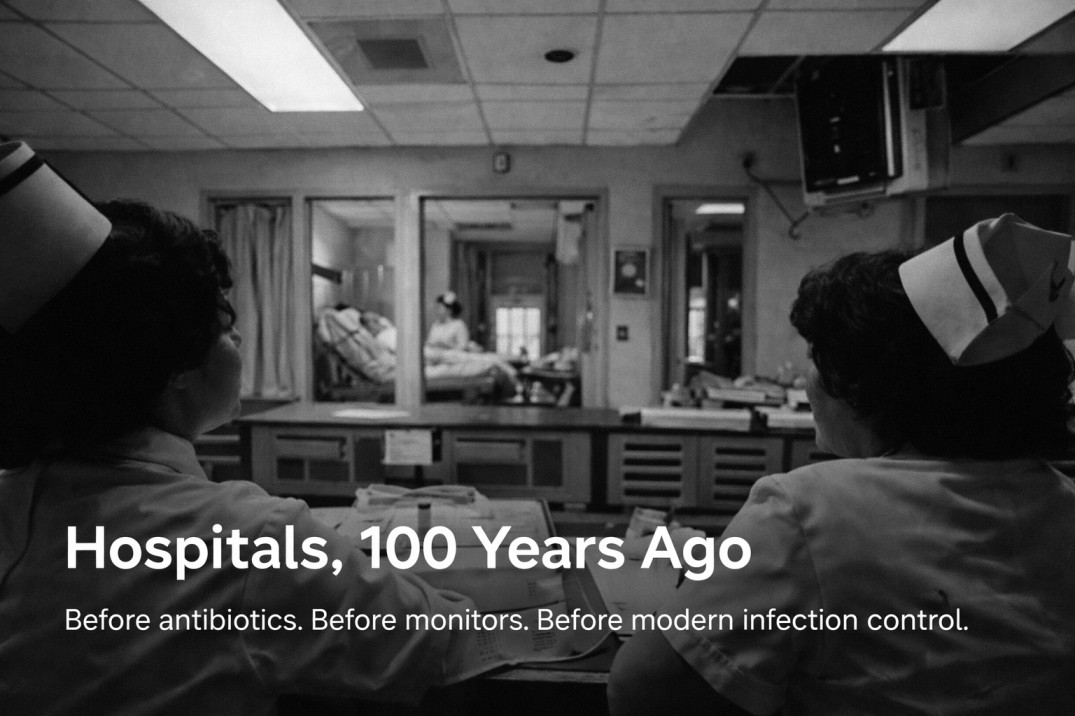
Hospitals today are filled with advanced machines, strict infection-control protocols, and specialized medical teams. But if you stepped into a hospital 100 years ago, the experience would feel shockingly different, especially by modern nursing and patient-care standards.
Understanding how hospitals looked and operated a century ago helps us appreciate how far healthcare has come and why modern practices save millions of lives today.
Hospital Buildings Were Simple and Often Overcrowded
Hospitals in the early 1900s were usually large, open buildings with long wards instead of private rooms. Dozens of patients were placed side by side, separated only by curtains or sometimes not separated at all.
Ventilation relied on open windows, even during cold weather, because fresh air was believed to prevent disease. Heating was inconsistent, and lighting often came from gas lamps or early electric bulbs.
Privacy was minimal, and noise from other patients, staff, and visitors was unavoidable.
Infection Control Was Limited
One of the biggest differences between hospitals then and now was infection prevention.
- Gloves were rarely used
- Handwashing was inconsistent
- Sterilization standards were still developing
Antibiotics like penicillin were not yet widely available, meaning even minor infections could become fatal. Surgical tools were reused frequently, and hospitals struggled with outbreaks of diseases such as tuberculosis, influenza, and pneumonia.
This is why hospital stays were often risky and sometimes more dangerous than staying at home.
Nurses Were the Backbone of Care
Nursing roles 100 years ago were demanding, physically exhausting, and often underpaid. Nurses:
- Worked long shifts (sometimes 12–16 hours)
- Lived in hospital dormitories
- Followed strict rules on behavior and appearance
Despite limited technology, nurses provided round-the-clock bedside care, including bathing patients, changing linens, administering basic
treatments, and offering emotional support.
Their discipline and dedication laid the foundation for modern nursing practice.
Surgery Was Fast but Risky
Without advanced anesthesia and antibiotics, surgeons focused on speed. The faster the operation, the lower the risk of infection or blood loss.
Operating rooms were basic, and monitoring equipment did not exist. Survival depended heavily on the surgeon’s skill and the patient’s overall health.
Many procedures we consider routine today were either extremely dangerous or not possible at all.
Who Went to Hospitals?
Hospitals were not always the first choice for care. In the early 1900s:
- Wealthy patients often received care at home
- Hospitals mainly served the poor, injured, or critically ill
- Many people avoided hospitals unless necessary
- Over time, as medical science improved and outcomes became safer, hospitals gained public trust.
How Hospitals Changed Over Time
The past century brought revolutionary changes, including:
- Antibiotics and vaccines
- Advanced diagnostic tools
- Strict infection-control protocols
- Specialized nursing and medical roles
- Patient-centered care models
These advancements transformed hospitals into places of healing rather than last resorts.
Why This Matters Today
Looking back at hospitals 100 years ago highlights:
- The importance of evidence-based practice
- The critical role of nurses in patient safety
- Why infection control saves lives
For today’s nursing students and healthcare professionals, history reinforces why standards exist and why they must never be compromised.