A Familiar Tool, A Different Role
Stethoscopes have represented clinical practice for many years, allowing providers to listen and make decisions through auscultation. Clinicians use their knowledge and experience to interpret the sounds.
However, sound is subjective. It depends on past experience and the clinical environment. The newest generation of stethoscopes uses technology to reduce this subjectivity.
From Sound to Signal
In the 1800s, René Laennec invented the original stethoscope design, allowing physicians to more accurately hear sounds from the human body. Innovations have enhanced its acoustics over time, but the physician’s ability to interpret what is heard has remained unchanged.
New digital technology has changed the path of stethoscopes. Early electronic models provided amplification and recording. In addition, smart stethoscopes convert sound into digital form for further analysis.
How the Device Works
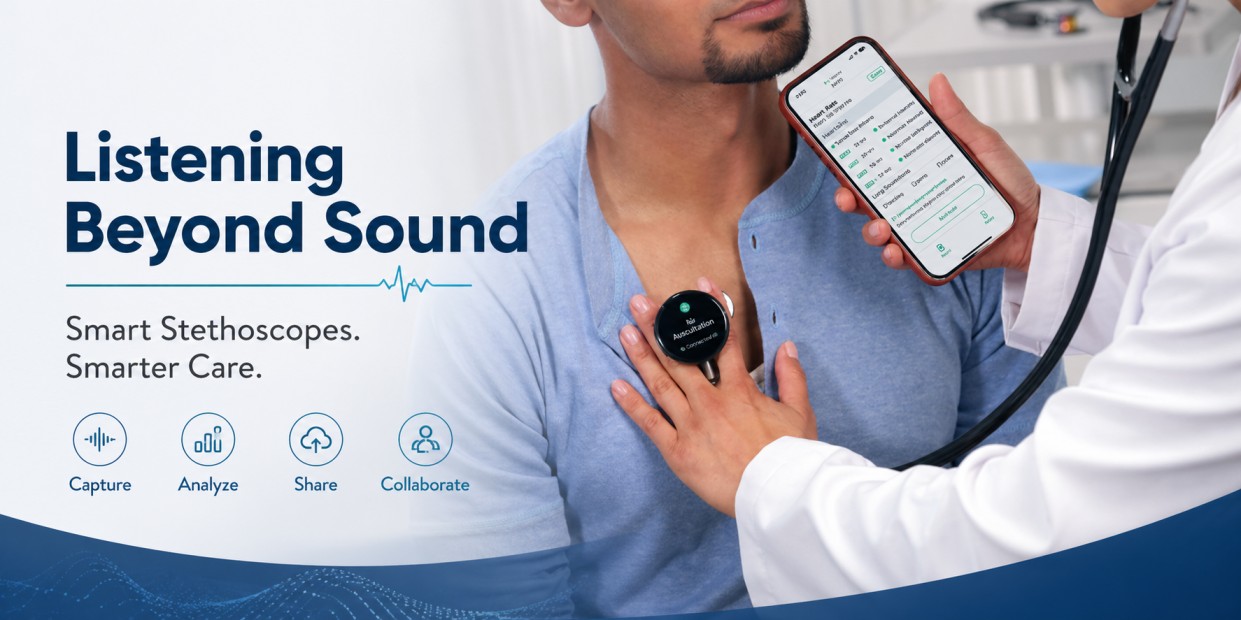
A smart stethoscope uses sensors to capture heart and lung sounds and converts them into digital signals. These signals can be viewed as waveforms and stored for later review. Some devices use algorithms to detect patterns such as murmurs, wheezes, or irregular rhythms. In addition to amplifying sound, they add a second level of analysis and support interpretation.
Beyond the Ear: What It Adds
Smart stethoscopes allow recording and playback of auscultated sounds. This reduces reliance on memory and supports more accurate clinical assessment over time.
They also allow data sharing. Other clinicians can review recordings for collaboration and second opinions.
They reduce the barrier of distance.
Auscultation can be performed and reviewed remotely.
Why This Shift Matters
Through auscultation, early signs of disease can be detected. These sounds can indicate important clinical changes. Missing them may delay accurate diagnosis.
Smart stethoscopes improve sound quality and reduce ambient noise. Their visual and analytical tools help identify patterns that may not be easily recognized by hearing alone.
However, the data supports decision-making.
Where Technology Can Mislead
Errors can still occur. Poor placement of the device can affect sound quality. External noise, such as background interruptions, can interfere with recordings.
Algorithms are not perfect. Some abnormal sounds may not be correctly identified. Over-reliance on automated output can lead to incorrect conclusions.
The device produces data.
The meaning depends on how it is used.
Data Feels Certain. It Isn’t Always
Electronic output appears accurate. Waveforms and classifications look precise.
However, these outputs are processed signals. Different devices and processors may handle the same sound differently.
The same input can produce different interpretations. The output may appear objective, but interpretation remains subjective.
Impact on Clinical Practice
Smart stethoscopes improve documentation and communication between clinicians and patients. They support remote monitoring and early detection. They also enhance teaching by allowing learners to see and hear patterns alongside instructors.
Their value depends on correct use and accurate interpretation. Technology can support clinical practice, but it cannot replace clinical judgment.
Final Reflection
Initially, stethoscopes converted sound into understanding. Today, digital versions convert sound into data.
They improve what we can hear. They record what may be missed.
But they provide data, not context.
Meaning still depends on how that data is interpreted and used.