Introduction
Traditionally, a diagnostic result is defined by the amount of the value you receive. It is a single measurement. That value is compared to a range of reference values. If needed, it is flagged as out of range. The clinician is responsible for interpreting the laboratory result.
The ability to differentiate between a measurement and its meaning has, for decades, been the foundation of laboratory medicine. That foundation is now beginning to change.
The Traditional Role of the Analyzer
Typically, analyzers provide highly accurate and reproducible data. They measure biochemistry, blood counts, and molecular signals. They use quantitation to determine the level.
The analyzer produces a value. It includes a normal, or relative, range. It also provides a flag.
After this point, the analyzer has no other function. It can only produce quantitative results. The remaining interpretation must be performed by someone else. This requires clinical judgement and situational awareness.
The Emergence of AI Integration
By using algorithm-based models, laboratory instruments and analyzers are able to identify patterns in laboratory data.
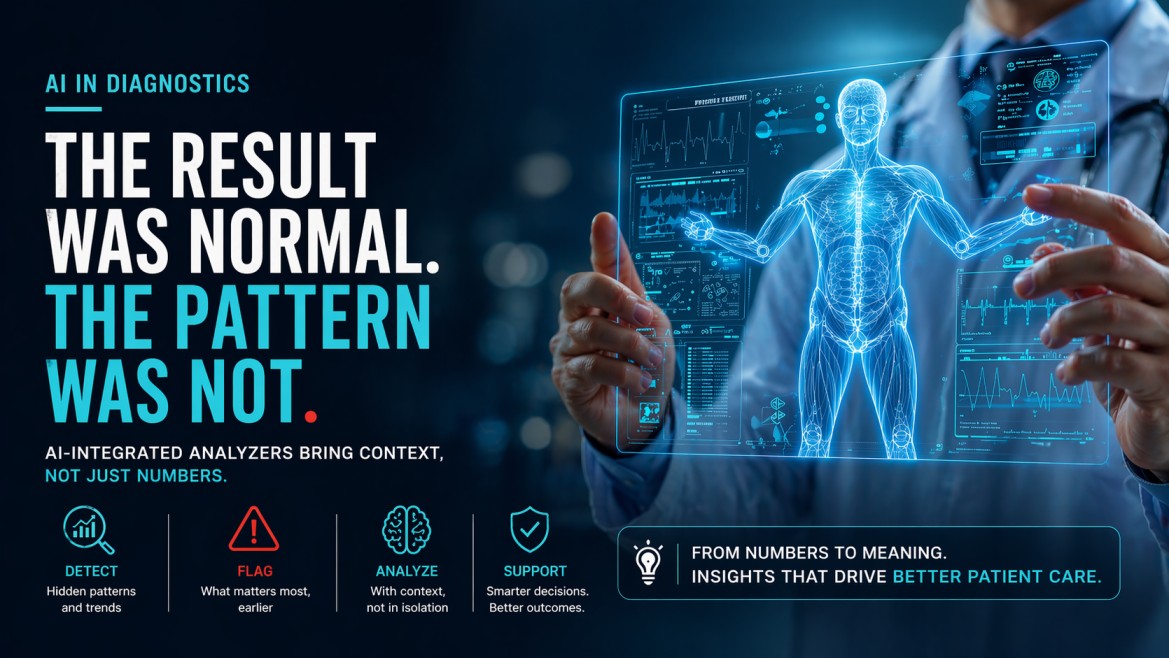
These systems can detect deviations from reference ranges. They can also detect deviations from established patterns. They compare current laboratory values with previous historical values. They identify trends.
They point out instances where results do not meet expectations. They highlight data inconsistencies. These may indicate issues related to preanalytical variation, such as sample collection, preparation, or transfer. They may also indicate analytical variation, such as instrument precision error. In some cases, they signal the need for immediate attention.
This creates a shift. Analytes are no longer measured in isolation. Data is used to evaluate multiple laboratory tests together.
From Measurement to Contextualization
An abnormal result shows an abnormality. It is flagged. An AI-motivated result begins to create context for that result as well.
A result within normal limits may still be increasing over time. This provides context on how significant the result is. A flagged result may have inconsistent previous values. This can be used to verify the abnormality.
As such, the analyzer provides two forms of assistance. It indicates the seriousness of the result. It also contextualizes the information surrounding the result.
The Limits of Automation
It is essential to acknowledge the limitations of existing systems, even with these advancements.
AI-based analyzers provide assistive tools. They support enhanced visibility of potential findings. They do not provide a definitive diagnosis. They do not include the full clinical context. They do not replace clinical judgment.
The ultimate responsibility remains with the clinician. Interpretation of findings and clinical recommendations must still be made by the clinician.
Implications for Clinical Practice
Modern healthcare environments are characterized by high data volume and limited time. Under such conditions, the ability to rapidly identify clinically significant results is critical.
By embedding elements of context into the analytical process, these systems assist in prioritizing attention, reducing the likelihood of overlooked abnormalities, and supporting more efficient clinical decision-making. This is not a replacement of expertise, but an augmentation of it.
A Gradual Transformation
Diagnostic analyzers do not develop rapidly. They evolve gradually. Changes are often small, with minor adjustments to interface and workflow.
However, their role is expanding. The device is becoming more active in the diagnostic process. It is no longer just a passive machine.
Conclusion
When viewed alone, a number will always have a place. However, its value in a clinical environment depends on meaning, context, and clinical relevance.
The inclusion of AI into clinical operations does not eliminate the need for interpretation. It shortens the time required to begin interpreting a number. It brings elements of meaning closer to the moment it is measured.
As a result, the diagnostic process becomes more than delivering data. It involves delivering informed, data-driven insights.