1. Stethoscope (1816)
Why it hasn’t changed:
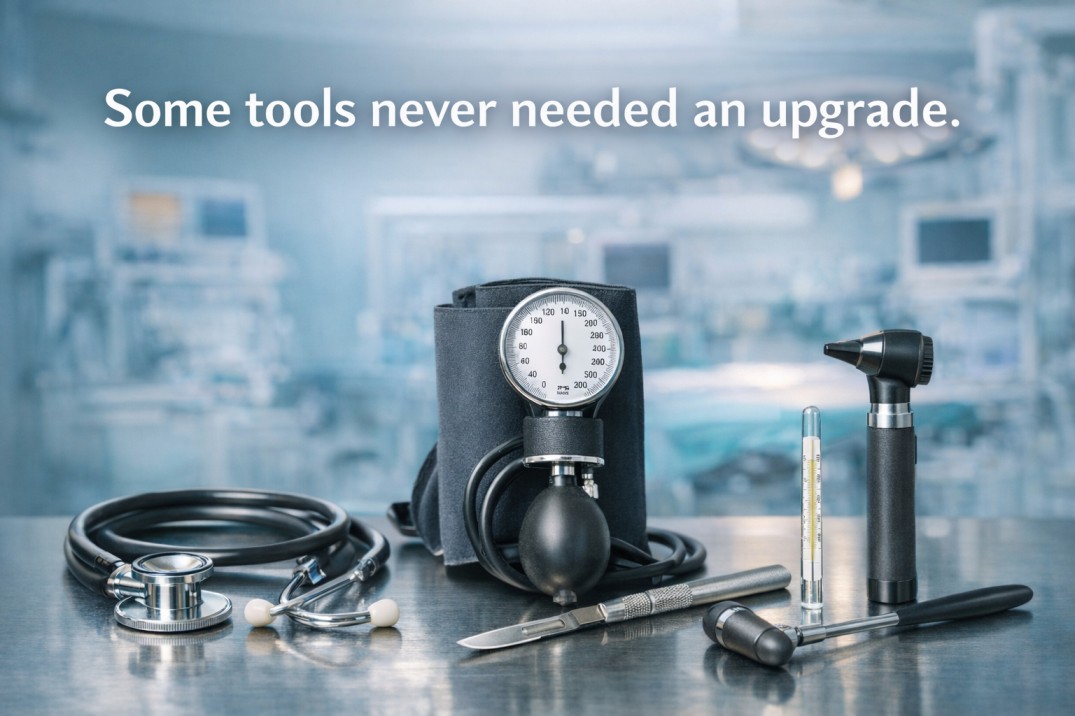
It allows doctors to listen directly to the body’s sounds—heartbeats, breathing, and bowel activity. While materials and sound quality improved, the basic design remains because it works reliably and creates a direct doctor–patient connection.
2. Scalpel (Modern form: 1800s)
Why it hasn’t changed:
Surgery demands precision and control. A sharp blade guided by a human hand still offers unmatched accuracy. No machine fully replaces the surgeon’s touch.
3. Blood Pressure Cuff (1896)
Why it hasn’t changed:
The cuff-based method is simple, accurate, and dependable. Digital versions exist, but the core principle remains the same and is still trusted worldwide.
4. Thermometer (Medical use since 1600s)
Why it hasn’t changed:
Measuring body temperature is a basic but vital sign. Whether mercury or digital, the purpose and method remain unchanged because they provide fast, essential information.
5. Reflex Hammer (Late 1800s)
Why it hasn’t changed:
It offers an instant neurological assessment. Simple tapping reveals nerve and spinal cord function—no technology does this faster or better.
6. Otoscope (Early 1900s)
Why it hasn’t changed:
Doctors still need a clear, direct view of the ear canal and eardrum. Improved lighting exists, but the core design remains the same.
7. Forceps (Ancient tool, modern medical use 18th–19th century)
Why it hasn’t changed:
Holding, grasping, and guiding tissue requires precise manual control. The shape has remained nearly identical because hands still need the same grip and balance.
8. Syringe (Late 1800s)
Why it hasn’t changed:
A barrel, plunger, and needle remain the most efficient way to deliver or withdraw fluids. Safety features improved, but the mechanism stayed the same.
9. Tongue Depressor (1800s)
Why it hasn’t changed:
It’s simple, disposable, cheap, and effective. There’s no safer or easier way to examine the throat.
Why These Tools Still Matter
- They work without electricity
- They are fast and reliable
- They are easy to learn and teach
- They function in any setting
- They keep medicine human
Sometimes, the best tools aren’t the newest ones—they’re the ones that got it right from the start.