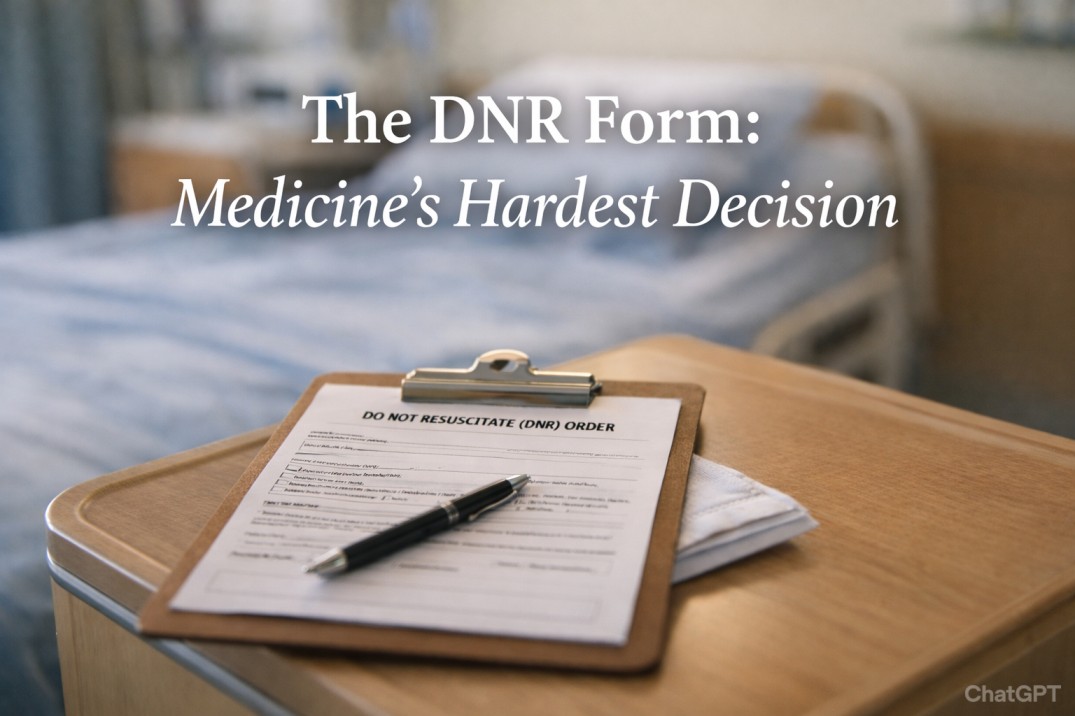
Not a machine.
Not a monitor.
A single sheet of paper.
Yet few documents in healthcare carry more weight.
How the DNR Order Began
In the 1960s, CPR moved from research to routine hospital practice. When a heart stopped, the response was automatic: resuscitate.
However, after a long period of time, the medical community was beginning to see that the application of CPR was affecting individuals who were frail, at the end of life and very unlikely to survive or would have to endure negative consequences if they did so.
The medical community has developed a methodology for restarting a heartbeat.
While at the same time has not completely developed an understanding of the conditions for which to apply these methodologies.
By the 1970s, hospitals introduced Do Not Resuscitate DNR orders, not to withhold care, but to respect a patient’s wishes and avoid unwanted CPR.
The DNR form was created for that reason: clarity, honesty, and choice.
A Change in Medical Practice
Before DNR policies, decisions about resuscitation were often informal and inconsistent. Some were made quietly. Some were not discussed at all.
The DNR order introduced structure.
It required conversation.
It required documentation.
It required agreement.
It marked an important shift: treatment decisions were no longer based only on what medicine could do, but also on what the patient wanted.
What a DNR Actually Covers
One of the most misunderstood parts of a DNR order is what it actually covers.
A DNR applies only if the heart stops beating or breathing stops. It does not mean no treatment, no medications, no oxygen, no hospital care, or no comfort measures.
A patient with a DNR can still receive full medical care. The order addresses one specific action: CPR during cardiac or respiratory arrest.
Clarity matters, because misunderstanding can create fear and conflict during already difficult moments.
Why It Matters in Medical Education
Knowing the policy of a DNR order as a healthcare professional or student is a responsibility, not simply an obligation. To administer CPR may save someone’s life; it may also result in great harm to someone already weak or gravely ill. DNR discussion requires clinical assessment/judgment, honest dialogue regarding the patient's current state of condition or need for resuscitation, and courage to talk about the end of life.
The form is simple.
The conversation behind it is not.
More Than Paperwork
The DNR document exists because medicine advanced. Once resuscitation became possible, boundaries had to be defined.
It represents an acknowledgment that survival at any cost is not always the goal.
In a field filled with technology and procedures, the DNR form stands apart. It does not measure, inject, or restart anything.
It records a choice.
And in healthcare, honoring that choice is as important as any treatment we provide.