In an operating room, there is a moment that carries enormous weight.
A surgeon removes a tumor and then asks, Did we get it all?
For decades, the answer required waiting. Tissue samples are sent to pathology. The patient remains under anesthesia. Sometimes, days later, results show cancer cells still at the margins, and another surgery becomes necessary.
Now imagine a scalpel that can answer that question instantly.
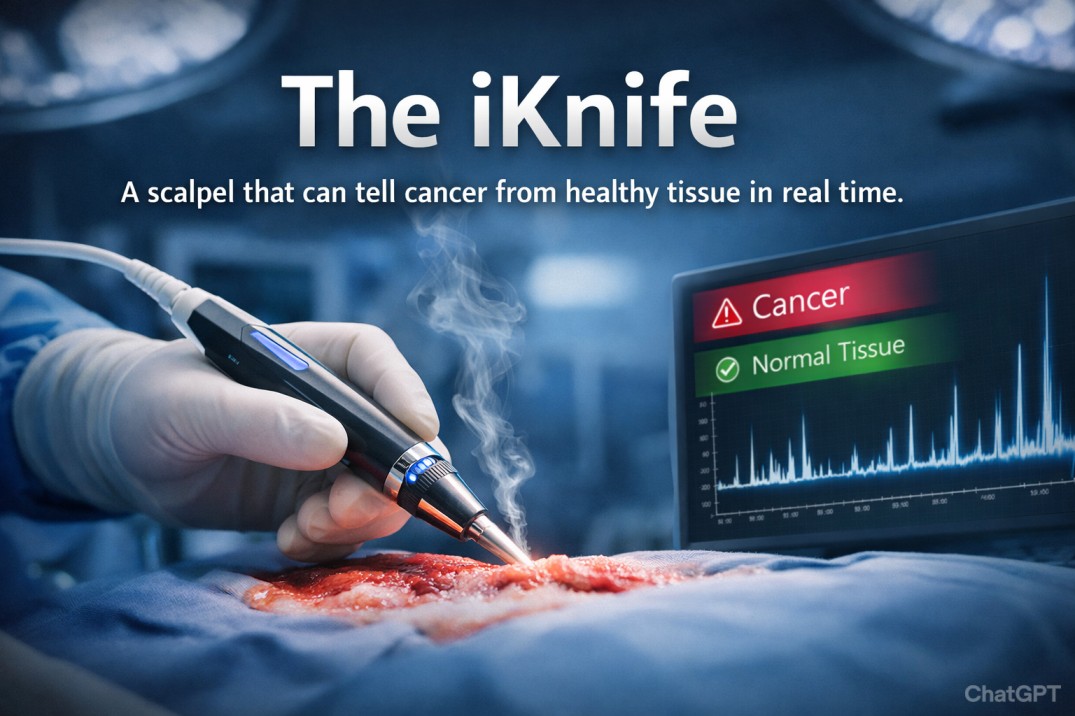
That is the promise of the iKnife, the intelligent knife.
How It Works (In Simple Words)
When performing electrosurgery, the use of electrosurgical cutting generates some smoke that typically gets suctioned away. The iKnife examines this smoke, detecting its chemical signature by means of rapid evaporative ionization mass spectrometry. Since cancerous and non-cancerous tissues have different molecular structures, the system can distinguish between them in just seconds.
With this information, the surgeon is able to determine whether the tissue is cancerous or non-cancerous and will not have to rely on the possibility of waiting before making a decision.
Why This Matters So Much
Cancer surgery is not just about removing a tumor. It is about removing enough tissue, but not too much.
If too little is removed, cancer may remain.
If too much is removed, healthy tissue is lost, affecting function and quality of life.
In breast cancer surgery, some patients need a second operation because microscopic cancer cells were left behind. That second surgery brings more stress, more anesthesia, more cost, and more emotional trauma.
The iKnife reduces that uncertainty by giving surgeons real time guidance while they operate.
Technology Meets Humanity
At first glance, this sounds like a story about AI and machines.
But it is really about people.
It is about:
- A mother who doesn’t need to come back for a second surgery.
- A patient who heals faster because less healthy tissue was removed.
- A surgeon who operates with greater confidence.
- A healthcare team that can provide clearer answers sooner.
Technology becomes meaningful only when it reduces human suffering. That is what makes the iKnife powerful.
Where It Stands Today
The iKnife has demonstrated strong potential for detecting malignant tumours in various forms of surgery, such as breast & GI cancer surgeries. Researchers are still improving the iKnife's database so that it can accurately identify more varieties of tissue.
The iKnife doesn't substitute for surgeons; rather, it supports them. This distinction is critical for understanding how the iKnife works.
A Glimpse of the Future Operating Room
The operating room of the future will not rely only on skilled hands. It will include intelligent tools.
- Scalpels that analyze.
- Monitors that predict.
- Systems that support decisions in real time.
Yet the heart of surgery will remain human judgment.
The iKnife represents more than a single device. It signals a move from reactive medicine to informed, real time precision.
In cancer care, that precision can mean the difference between uncertainty and hope.