When Sound Slowly Disappears
Hearing deficits usually develop over time. Voices become less distinct, conversations become harder to follow, and background sounds begin to overpower speech.
For many people, hearing loss affects more than sound. It can reduce communication, confidence, relationships, and connection with the world around them.
This is where the hearing aid becomes an important tool.
How the Idea Began
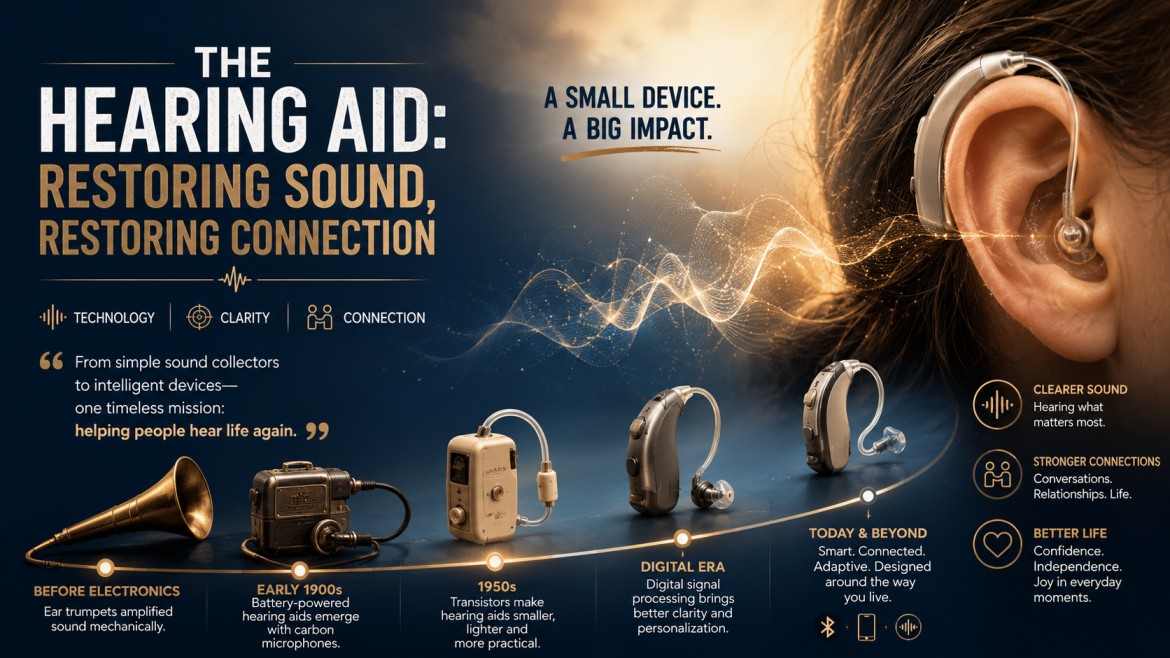
Before electronic devices existed, ear trumpets were used to collect and direct sound toward the ear. Their ability to amplify sound was limited and depended heavily on positioning and environment.
The invention of the telephone by Alexander Graham Bell in 1876 greatly improved sound transmission technology. In the early 1900s, companies such as Akouphone Company introduced battery-operated electronic hearing aids using carbon microphones.
By the 1950s, transistor technology allowed hearing aids to become much smaller and more practical. Continued advances in digital sound processing later improved sound quality and allowed devices to adapt more effectively to individual hearing needs.
What a Hearing Aid Does
A hearing aid is a small electronic device designed to help individuals with hearing impairment by amplifying and processing sound. Most modern hearing aids contain a microphone, a processor, and a speaker.
The microphone captures surrounding sounds. The processor modifies these sounds according to the user’s hearing needs, and the speaker delivers the amplified sound into the ear.
Modern devices can also reduce background noise, improve speech clarity, and automatically adjust performance based on the surrounding environment.
More Than Amplification
Hearing aids amplify sound - but they do much more than just make sounds louder. They help people hear meaningful sounds (particularly when speaking) more clearly.
There are different frequencies of sound that are amplified differently based on your type of hearing loss. For instance, consonants (high-frequency sounds) are often among the hardest to hear, and generally require more amplification than low-frequency sounds.
The way to think about your hearing aid as being helpful to you isn't just about getting louder - it's also about clarity and being able to communicate.
How Modern Devices Have Evolved
Recent developments in technology have enabled hearing aids to use Digital Signal Processing (DSP) to constantly evaluate sound. Many modern hearing aids now connect wirelessly with mobile phones, televisions and other devices. There are also devices that feature directional microphones that are able to concentrate on speech coming from certain angles.
Some hearing aids automatically identify their surrounding environment (i.e. still or busy room, outside) and will adjust the hearing aids' sound processing automatically accordingly.
The ability for the device to adjust its sound processing based on what environment it is has made it much more intelligent.
However even though technology and hearing aids have improved tremendously the way that we perceive hearing is still primarily a function of how we process sound through our brain.
Where Challenges Remain
While hearing aids enhance hearing ability, they won't return you to hearing perfectly. Background noise levels can still affect how well we can understand others when they speak. Many people who have experienced an extended amount of time with no hearing have a hard time adjusting to using an amplified sound because they have not experienced it for quite a while.
If a hearing aid is not fitted properly, calibrated well, or you don't use it consistently, it won't work as intended.
There are also things such as feedback, discomfort, etc., that may make using it difficult.
How the device is supposed to help you.
Adjustment to the aid is still necessary and will take time.
Why It Matters
Communication, learning, safety, and social interaction are all impacted by hearing. People who don't treat their hearing loss are often isolated, frustrated, and live with a lower quality of life than those who treat it.
Hearing Aids enable people to re-engage with conversations they may have had in the past, their family, and daily life, which may seem like forever ago.
Their effect is both emotional and functional.
The Human Side of Sound
For a lot of people, the first time they hear clearly can be very emotional; the first time they hear everyday sounds (e.g., footsteps, laughter, or a familiar voice) in many years of reduced hearing can feel very emotional.
A hearing aid can do much more than enhance your ability to perceive different sounds. It can also enhance your ability to interact and connect with others.
Closing Thought
Hearing aids have been engineered to assist the gradual loss of a sense that many individuals experience. They take in ambient sounds and enhance them at a frequency that is no longer perceived properly through the human ear.
However, the real benefit of hearing aids does not come solely from technological design. Hearing aids also serve to remake a connection to individuals, conversation, and the everyday aspects of living by providing an ability to hear again.