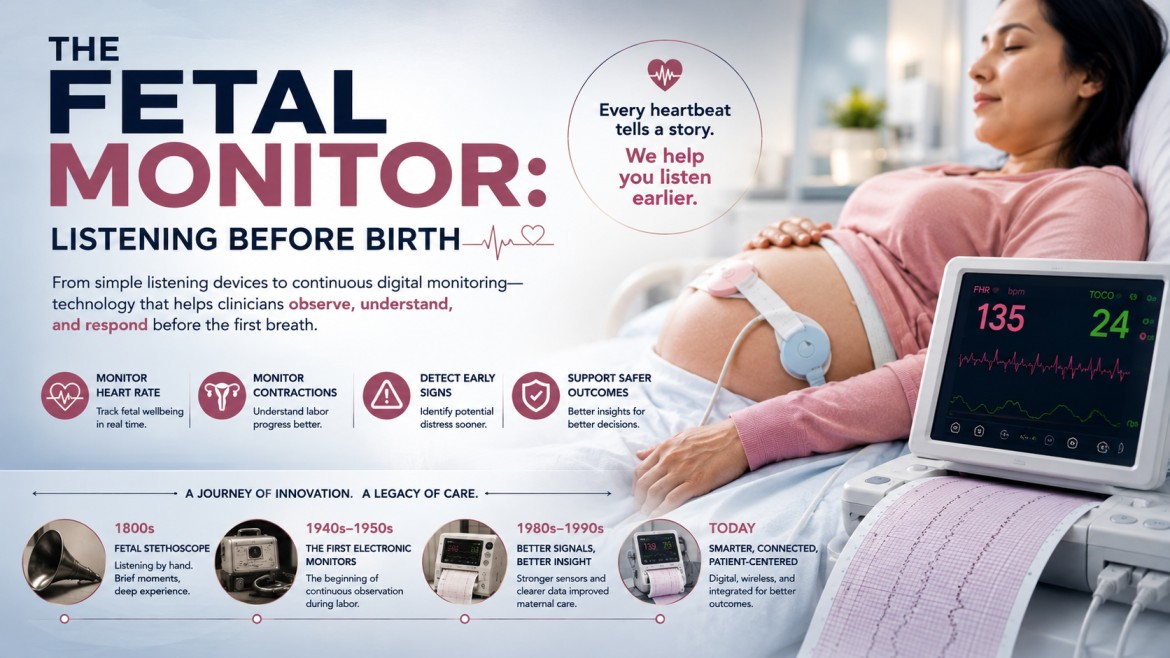
Monitoring Life Before the First Breath
Important signs of life can be observed long before a baby is born. During pregnancy and labor, clinicians monitor the baby’s heart rate and the mother’s contractions to assess how the fetus is responding inside the womb. Abnormal patterns in these signals may provide early warning signs of stress or complications.
At this stage, the fetal monitor becomes an important part of modern maternal care. Through fetal monitoring, healthcare providers can hear, observe, and respond to signs from the baby before birth occurs.
How the Idea Began
For much of history, doctors had limited ways to assess a baby’s condition before birth. They relied mainly on physical examination and listening for the fetal heartbeat using simple instruments.
In the 1800s, the fetal stethoscope allowed clinicians to hear the baby’s heartbeat through the mother’s abdomen, but it only provided brief information and depended heavily on the clinician’s experience.
During the 1940s and 1950s, advances in ultrasound and electronic sensor technology introduced continuous fetal monitoring for the first time. Clinicians could now observe fetal heart rate and uterine contractions throughout labor in real time.
Today’s computerized fetal monitors continuously record fetal heart patterns and uterine activity and are routinely used in labor rooms, maternity wards, and prenatal clinics worldwide.
What a Fetal Monitor Does
A fetal monitor is a medical device used to observe the baby’s heart rate and the mother’s uterine contractions during pregnancy and labor. Most systems use two sensors placed on the mother’s abdomen. One sensor uses ultrasound to measure fetal heart activity, while the other measures uterine contractions.
The device converts these signals into continuous visual graphs and sound patterns that clinicians can interpret in real time. These recordings help healthcare providers assess how well the fetus is tolerating labor and determine whether medical intervention may be necessary.
More Than Just a Heartbeat
The fetal monitor is designed not only to detect fetal heart rate, but also to help clinicians analyze heart rate patterns such as variability, accelerations, and decelerations. These patterns can provide insight into how the fetus is responding to oxygen levels, contractions, and stress during labor.
By reflecting the baby’s condition in real time, the fetal monitor can also assist clinicians in making decisions about further medical intervention during delivery.
In this way, the fetal monitor functions as both a recording tool and a clinical decision-support device during one of the most critical stages of life.
How Modern Systems Have Evolved
Modern fetal monitoring systems are far more advanced than earlier devices.
Many systems now include:
- Digital signal processing
- Wireless monitoring capabilities
- Centralized monitoring stations
- Portable telemetry systems
- Integrated maternal and fetal monitoring
Some devices allow mothers greater mobility during labor while maintaining continuous monitoring. Others store digital records that can be reviewed later for clinical assessment.
Advances in software and sensor technology have also improved signal quality and reduced interference during monitoring.
Where Challenges Remain
Fetal monitoring has become common, but interpreting fetal heart rate patterns is not always straightforward. Different clinicians may interpret the same pattern differently, especially in borderline situations. In some cases, misinterpretation can lead to unnecessary interventions.
Signal quality may also be affected by fetal movement, the mother’s position, or external interference.
Because of this, fetal monitoring should be combined with clinical judgment, patient examination, and the overall obstetric assessment.
Why It Matters
Pregnancy and childbirth involve many physical changes for both the mother and baby. The fetal monitor allows continuous observation of these changes and can provide early warning signs of possible complications, including fetal distress, before obvious symptoms appear.
Fetal monitoring is especially important in high-risk pregnancies, prolonged labor, and situations where continuous clinical observation of the fetus is necessary.
By helping clinicians assess fetal wellbeing before birth, the fetal monitor supports safer maternity and neonatal care.
The Human Side of Monitoring
Listening to a fetal heartbeat is often an emotional experience for parents. The rhythmic sound creates a connection with the baby long before birth.
For clinicians, these signals are medically important; for families, they provide a personal and tangible connection to the child before delivery.
The fetal monitor combines technology and human emotion by supporting medical observation while strengthening the connection between parent and baby.
Closing Thought
The fetal monitor was designed to observe one of the most sensitive stages of human life before birth.
From early audio devices to today’s digital systems, fetal monitoring technology has evolved significantly and now provides continuous, detailed information about fetal wellbeing during pregnancy and labor.
The goal of fetal monitoring is simple,
but its impact on childbirth is profound.