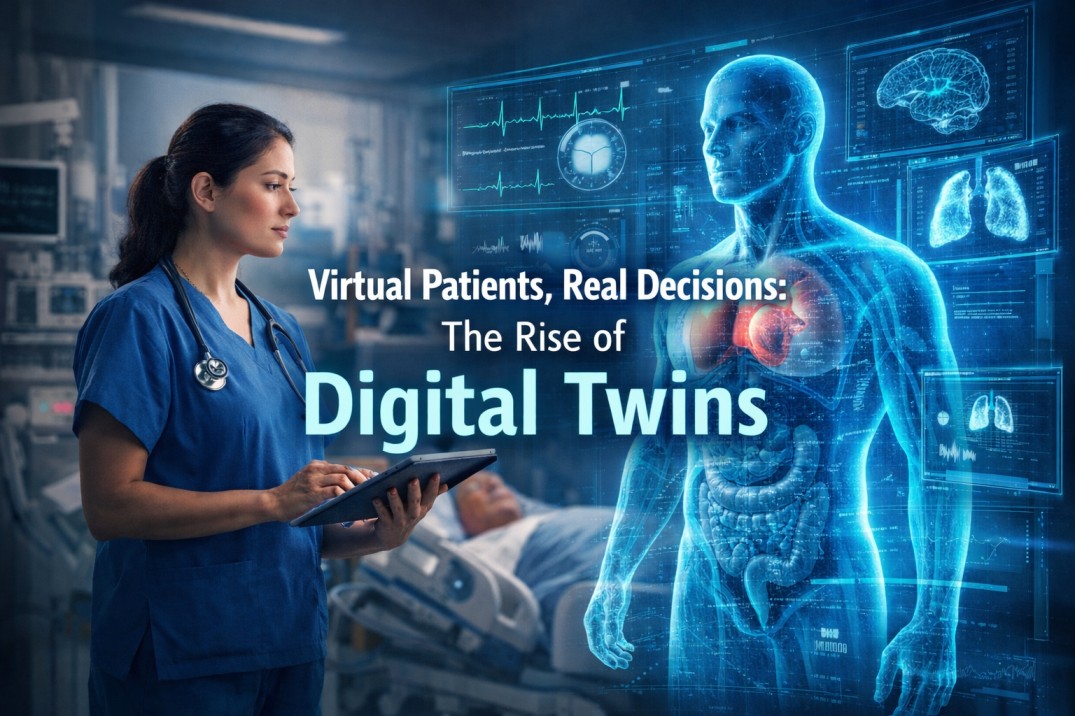
Consider a situation where you can test out a patient’s treatment plan before you actually treat them. This is exactly what Digital twins has the potential to do for patients in healthcare. The ICU is one place where this new technology is getting noticed; by giving care teams the ability to treat with confidence rather than guessing, digital twins make it easier for providers to provide better patient outcomes while reducing risk to patients due to harmful treatments.
What Is a Digital Twin in Healthcare?
A digital twin is a living 3D model of a patient built from real clinical data. Unlike static tools, it continuously updates as new information becomes available.
Core inputs include:
- Vital signs
- Lab results
- Imaging data
- Medications
- Ventilator settings
As the patient’s condition changes, the digital twin changes too. This allows clinicians to safely run “what if” scenarios in a virtual space before making real clinical decisions.
How the Technology Works
The workflow behind digital twins in healthcare generally follows four steps:
1. Data Collection
Continuous patient monitoring, much of it performed and documented by nurses, feeds high frequency data into the system.
2. Model Construction
Advanced computational models create a personalized virtual representation of the patient or specific organ systems.
3. Simulation of Interventions
Clinicians can test potential changes, such as drug dosing or ventilator adjustments, within the digital twin.
4. Clinical Decision Support
The care team reviews predicted outcomes before applying changes at the bedside.
This process aims to reduce uncertainty in critical decision-making.
Why Digital Twins Matter in the ICU
In an ICU setting, situations may change rapidly; therefore, clinicians will typically use either personal knowledge or established guidelines or live patient data and observations to provide care.
This combination of experience and protocol may provide the best solution when providing care but is still based on trial and error through constant evaluation.
Digital twins allow for prediction of outcomes prior to making any decisions.
Potential benefits:
- More personalized treatment
- Less trial and error
- Earlier warning of deterioration
- Better risk checks before interventions
Because ICU patients are closely monitored, this setting is especially well suited for digital twin technology.
Key Clinical Applications
1. Customized Medication Dosing
Different patients react differently to medications. Digital twins can be utilized to model all the possible doses available to give to the patient and assist health care providers in choosing the appropriate and safest dose for that patient.
2. Management of Ventilators
Even small adjustments to a patient’s ventilator can have a very strong influence on the patient’s lungs. A digital twin can be used to predict the effect of any adjustments made to the ventilator on the patient and assist in avoiding unsafe adjustments.
3. Early Detection of Patient Decline
Through the continuous assessment of incoming data, digital twins may identify small early signs of a patient declining faster than with routine monitoring, providing the opportunity to address the patient sooner and thus reduce complications.
The Critical Role of Nursing Data
Digital twins rely on accurate, continuous bedside data, and nurses are at the heart of this process. Monitoring vitals, documenting changes, and managing devices all shape the quality of the model. In simple terms, a digital twin is only as reliable as the data it receives. This highlights an important truth: advanced technology works best when it supports, not replaces, frontline clinical care.
Current Challenges and Limitations
Despite growing interest, important hurdles remain. Many hospitals still struggle with fragmented data systems, and incomplete or delayed data can weaken model accuracy. Digital twins also need strong clinical validation across diverse patient groups before they can be widely trusted in high risk settings. Integrating these tools into busy ICU workflows must be done carefully to avoid alert fatigue. Clear rules around liability, algorithm transparency, and clinical responsibility are still evolving.
Human Judgment Still Matters
Digital twins are meant to support, not replace, clinical decisions. Bedside assessment, experience, and nursing vigilance remain essential. In the near term, the most realistic path is collaboration, with digital twins serving as an added layer of insight for care teams.
What the Research Suggests
Recent discussions in the Journal of Personalized Medicine (MDPI) describe digital twins as a promising step toward more individualized critical care. Early findings suggest they may reduce unnecessary treatment changes and improve prediction of patient response. However, broader clinical validation is still needed before routine ICU deployment.
Future Outlook
Advancements in real-time patient monitoring, AI and modeling algorithms, greater hospital data systems, and connected wearable devices are rapidly increasing the momentum of the digital twin concept in healthcare. These technologies will eventually reach an appropriate level of maturity resulting in digital twins being incorporated into new precision medicine approaches as a standard component of precision care for critically ill patients.
Conclusion
Digital twins are a major step forward in personalized medicine. By letting clinicians test treatments on virtual patients first, they support safer and more informed decisions in the ICU.
Widespread use will still require careful validation and thoughtful integration. But the path is clear. When paired with strong clinical judgment and quality nursing care, digital twins can become a trusted bedside partner, helping critical care shift from reactive responses to more precise, forward looking care.