When Light Becomes Part of Care
Most people associate light with sight, heat, or energy. In medicine, however, light can also be used as treatment.
One common example is neonatal phototherapy, where newborns with jaundice are exposed to specific fluorescent or LED light under strict protocols. For many infants, especially those born prematurely, this becomes an important part of their first days of life.
Phototherapy units deliver the precise wavelengths of light needed to help newborns process substances their bodies cannot yet remove effectively on their own.
How the Idea Began
Light has been used in medicine for centuries, but the use of light to treat newborn jaundice began unexpectedly in the 1950s. Nurses at Rochford Hospital noticed that newborns placed near sunlight had lower levels of jaundice. Researchers later confirmed that specific wavelengths of blue light could change bilirubin into forms the body could remove more easily.
This discovery led to the development of artificial phototherapy devices for newborn care. Over time, older fluorescent systems were replaced by safer and more efficient halogen and LED technologies.
Today, phototherapy units are routinely used in NICUs, maternity wards, and pediatric units worldwide.
What a Phototherapy Unit Does
A phototherapy unit is a medical device commonly used to treat neonatal jaundice through controlled light exposure. Neonatal jaundice occurs when excess bilirubin builds up in the blood, causing yellow discoloration of the skin and eyes. Because a newborn’s liver is still immature, it may not remove bilirubin effectively.
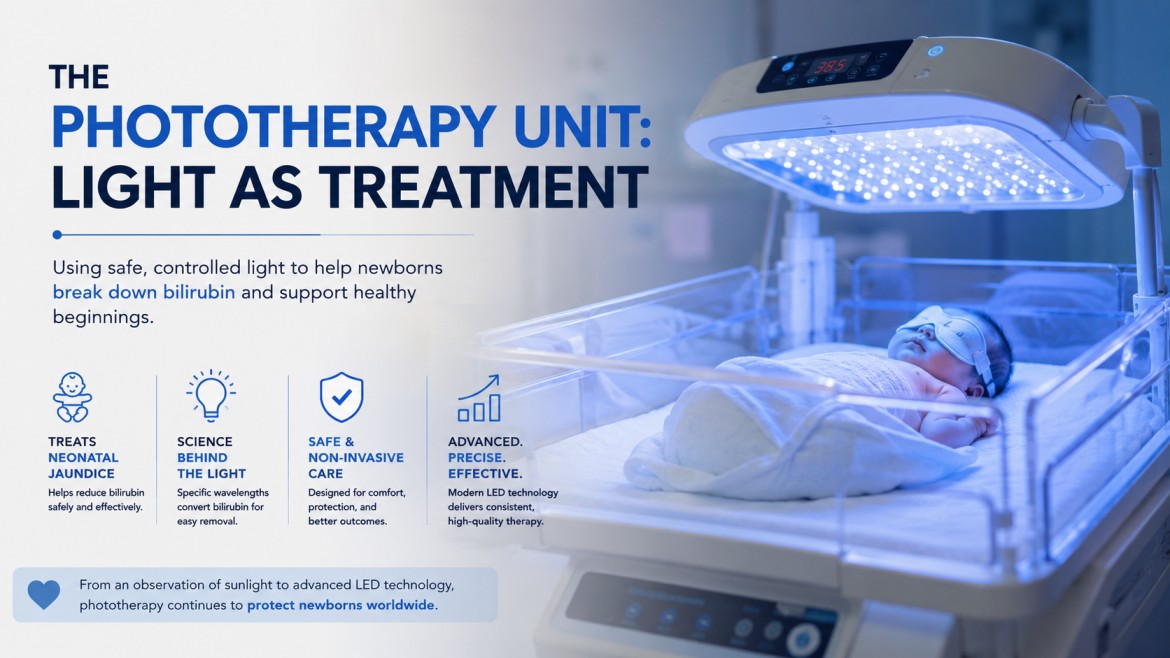
The phototherapy unit exposes the infant’s skin to specific wavelengths of blue light, converting bilirubin into forms that can be removed through urine and stool.
The treatment is non-invasive and is usually performed while the infant remains in an incubator or warmer.
More Than Just a Lamp
Although phototherapy may appear simple, the treatment depends on carefully controlled medical parameters. Its effectiveness is influenced by the light wavelength, intensity, distance from the patient, surface area exposed, and duration of treatment.
Modern systems are designed to maximize therapeutic light exposure while maintaining patient safety and comfort. Eye protection is also commonly used to protect the infant’s developing eyes during treatment.
Even small changes in treatment conditions can significantly affect clinical outcomes in newborn care.
How Modern Systems Have Evolved
Modern phototherapy units are far more advanced than earlier systems. Many now use LED technology, which provides more precise wavelengths, lower heat production, reduced energy consumption, longer operational life, and more consistent treatment delivery.
Some devices are portable, while others are integrated directly into incubators and neonatal care stations. Fiber-optic phototherapy blankets have also been developed, allowing some infants to receive treatment while being held or fed, improving comfort and parent interaction during therapy.
Digital monitoring systems now help clinicians track treatment duration, light intensity, and patient response more accurately.
Where Challenges Remain
Although phototherapy is considered safe and effective, careful monitoring during treatment remains essential. Clinicians must regularly assess bilirubin levels, hydration status, body temperature, skin condition, and treatment duration.
Insufficient exposure may reduce treatment effectiveness, while unnecessarily prolonged therapy can increase stress for both infants and families. Premature infants often require even closer monitoring because of their greater medical vulnerability.
Like any medical technology, successful phototherapy depends not only on the device itself,
but also on careful clinical assessment and monitoring.
Why It Matters
Jaundice is common in newborns, especially in premature infants. If left untreated, high bilirubin levels can lead to serious neurological complications.
Phototherapy provides a safe and effective way to reduce bilirubin levels and has helped decrease the need for more invasive treatments such as exchange transfusions.
For clinicians, phototherapy represents both an important technological advancement and a highly effective method of protecting newborns during one of the earliest stages of life.
The Human Side of Light Therapy
For parents, seeing a newborn placed under blue therapeutic light can feel unfamiliar and frightening at first. However, the light is an important form of treatment that helps protect the baby’s developing brain during one of the most critical stages of life while supporting recovery after birth.
In hospitals around the world, phototherapy works alongside incubators, monitors, and neonatal care teams to help newborns safely through their first days of life.
The goal of phototherapy is simple:
to use light to support the body’s natural healing process.
Closing Thought
The phototherapy unit transformed an observation about sunlight into one of the most widely used treatments in newborn care. From early fluorescent systems designed to imitate sunlight to today’s advanced LED technology, phototherapy has become an essential part of treating neonatal jaundice.
Its development demonstrates that effective treatment does not always require surgery or medication. In some cases, therapeutic benefit can be achieved through carefully controlled light alone.