When it comes to education, one of the most widely used frameworks for learning and teaching is Bloom’s Taxonomy. Developed in 1956 by Benjamin Bloom and his colleagues, this model has guided teachers, trainers, and students worldwide in setting clearer learning goals and achieving deeper understanding.
For future nurses, understanding Bloom’s Taxonomy is not only helpful in studying for the PNLE but also in applying knowledge in clinical practice. This is why 1NURSE aligns its review tools and daily Q&A with Bloom’s framework so learners don’t just memorize but also learn to analyze, evaluate, and create solutions in real-world nursing situations.
What is Bloom’s Taxonomy?
Bloom’s Taxonomy is a hierarchical model that classifies learning objectives into levels of complexity and depth. The idea is simple: learning is not just about remembering facts—it’s about building skills step by step until you can apply, analyze, and create new knowledge.
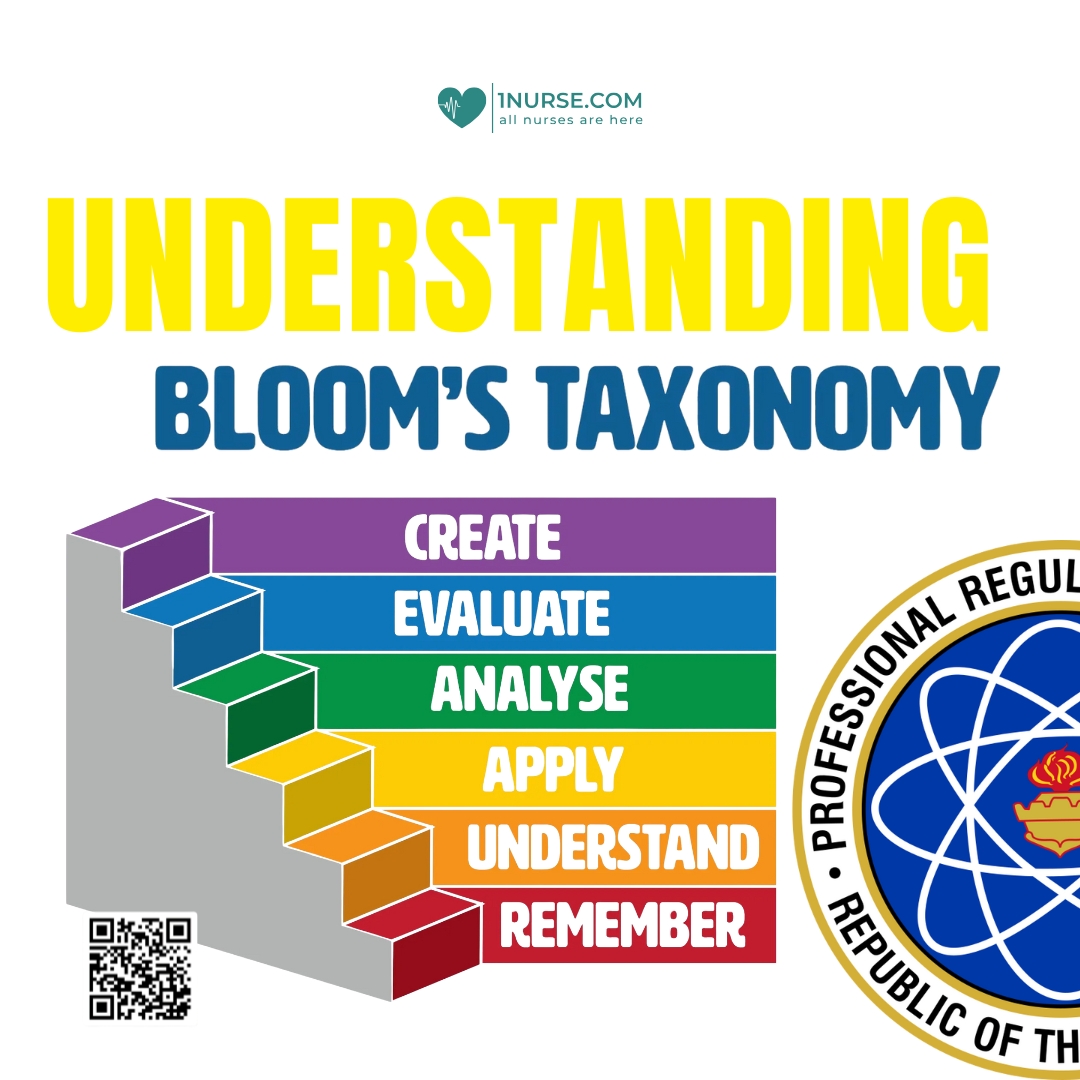
The taxonomy is often visualized as a pyramid, with each level building upon the one before it. The revised version (2001) identifies six main levels:
Remembering – Recalling facts and basic concepts (e.g., define, list, memorize).
Understanding – Explaining ideas or concepts (e.g., summarize, explain, classify).
Applying – Using knowledge in new situations (e.g., solve, demonstrate, use).
Analyzing – Breaking information into parts and examining relationships (e.g., compare, differentiate, organize).
Evaluating – Making judgments based on criteria (e.g., critique, argue, justify).
Creating – Producing new or original work (e.g., design, construct, invent).
Why is Bloom’s Taxonomy Important for Nursing Students?
Nursing education is more than memorizing drugs and procedures. It requires critical thinking, sound judgment, and problem-solving. This is where Bloom’s Taxonomy plays a vital role.
For students: It helps identify whether you are simply memorizing or moving toward deeper understanding.
For educators: It ensures that exams and lectures are designed to train critical thinking, not just recall.
For 1NURSE users: It means every daily Q&A, mock test, and review module is built not only on updated Board of Nursing guidelines but also on Bloom’s framework, ensuring a smarter and more effective study journey.
Practical Applications in Learning
Here’s how Bloom’s Taxonomy can be applied:
In Nursing Education: Memorizing drug names (Remember), explaining how they work (Understand), applying knowledge in patient care (Apply), analyzing case studies (Analyze), evaluating treatment options (Evaluate), and developing care plans (Create).
In Business: Remembering market terms, understanding trends, applying strategies, analyzing data, evaluating risks, and creating business models.
In Daily Life: Remembering a recipe, understanding cooking techniques, applying them in the kitchen, analyzing why a dish failed, evaluating flavors, and creating your own recipe.
How 1NURSE Applies Bloom’s Taxonomy
Remembering: Quick drills and flashcards help you recall key terms and concepts.
Understanding: Rationales in every Q&A ensure you grasp the “why” behind each answer.
Applying: Case-based questions simulate real clinical scenarios.
Analyzing: Review trackers and progress reports guide you in identifying strengths and weaknesses.
Evaluating: Mock exams challenge you to make decisions under exam pressure.
Creating: Study planners and personalized strategies help you design your own review approach.
Tips for Nursing Students
Begin with remembering and understanding through daily Q&A.
Push yourself to apply and analyze with case-based exams.
Use the rationale explanations to evaluate your choices.
Maximize 1NURSE’s review tracker to create a personalized study plan that matches your progress.
Final Thoughts
Bloom’s Taxonomy reminds us that true learning goes beyond memorization. In nursing, it means moving from knowledge to action. Being able to recall, understand, apply, and make critical decisions that save lives.
1NURSE helps you achieve exactly that. By integrating Bloom’s framework into its review system, it prepares you not just to pass the PNLE but to think and act like a professional nurse.
Your journey to becoming an RN is not just about studying harder, it’s about studying smarter with 1NURSE.