When Breathing Stops Quietly
Sleep restores both the mind and body. However, some people repeatedly stop breathing during sleep without realizing it, causing low oxygen levels and disrupted sleep.
This condition is called obstructive sleep apnea (OSA). One of the most important technologies used to treat it is the CPAP machine.
CPAP, or continuous positive airway pressure, has become one of the most effective long-term therapies for sleep-related breathing disorders.
How the Idea Began
Before sleep medicine became a recognized specialty, many cases of sleep apnea went undiagnosed. Snoring, morning headaches, fatigue, and poor concentration were often considered normal problems rather than signs of a medical condition.
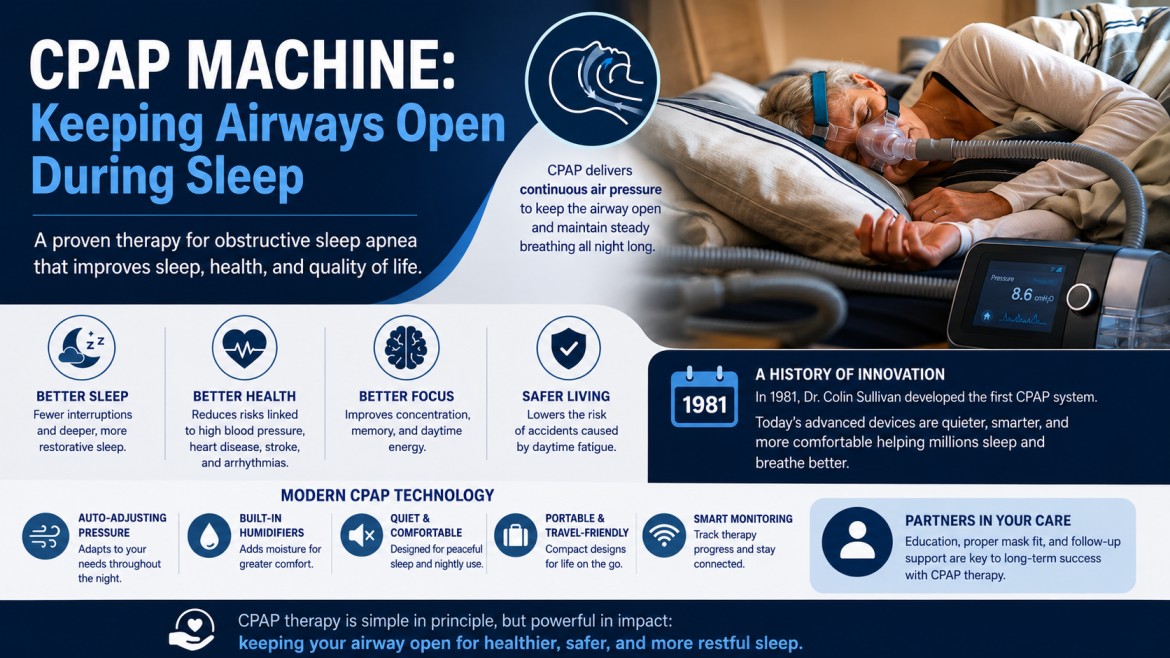
During the 1970s and early 1980s, researchers studied how airway collapse during sleep interrupted breathing and reduced oxygen levels. In 1981, Australian physician Colin Sullivan developed the first CPAP system. His idea was simple but revolutionary: use continuous air pressure to keep the airway open during sleep.
Although early machines were bulky and noisy, they proved that maintaining airway pressure could prevent repeated breathing interruptions throughout the night, transforming sleep medicine worldwide.
What a CPAP Machine Does
A CPAP machine is a device that provides continuous airflow through the airways during sleep. Most systems contain a motor that generates airflow, tubing that carries the air, a mask placed over the nose or mouth, and in some models, a humidifier for added comfort. The machine delivers constant air pressure to help prevent the soft tissues of the throat from collapsing during sleep.
Importantly, the CPAP machine does not breathe for the patient. Instead, it supports natural breathing by keeping the airway open and maintaining stable oxygen levels throughout the night.
Why Sleep Apnea Matters
Sleep apnea is more than loud snoring or a poor night’s sleep. Repeated interruptions in breathing can lower oxygen levels and place continuous stress on the body. Untreated obstructive sleep apnea has been linked to high blood pressure, heart disease, stroke, heart rhythm disturbances, daytime fatigue, poor concentration, and increased accident risk.
In severe cases, the body may remain in repeated cycles of interrupted oxygen supply during sleep. CPAP therapy helps reduce this stress by maintaining more stable breathing patterns throughout the night.
How Modern Systems Have Evolved
Modern CPAP devices are far more advanced than earlier systems. Many now include automatic pressure adjustment, heated humidifiers, noise reduction technology, portable travel-friendly designs, wireless monitoring, and digital compliance tracking.
Some systems can automatically detect breathing changes and adjust airway pressure throughout the night according to the user’s needs. Mask designs have also improved significantly, becoming lighter, quieter, and more comfortable for long-term use.
These advancements have made CPAP therapy more practical, accessible, and widely accepted for millions of users worldwide.
Where Challenges Remain
Although CPAP therapy is highly effective, adjusting to the device can still be difficult for some patients. Individuals may experience claustrophobia from the mask, nasal dryness, skin irritation, difficulty tolerating airflow pressure, or interrupted sleep while adapting to the device.
Long-term success with CPAP often depends on proper patient education, correct mask fitting, regular follow-up, and gradual adaptation to therapy. Even with advanced technology, human support remains an essential part of successful treatment.
The Human Side of Sleep Therapy
For many people, adjusting to a CPAP machine can initially feel uncomfortable. The sound of airflow and the presence of tubing beside the bed may take time to get used to.
Over time, however, many users begin to associate the CPAP machine with restful sleep, improved daytime energy, clearer thinking, and safer breathing throughout the night. Families may also find reassurance knowing their loved one is breathing more consistently during sleep.
The purpose of the CPAP machine is simple:
to help people continue breathing safely during the hours when the body is most vulnerable and least aware.
Closing Thought
The CPAP machine treats sleep apnea using a simple principle: keeping the airway open during sleep. From the first experimental systems developed in the 1980s to today’s advanced computerized devices, CPAP technology has greatly improved sleep quality, oxygen stability, and long-term health for millions of people worldwide.
Although a CPAP machine works quietly beside the bed, its impact on human health can be significant and sometimes life saving.