When Breathing and Circulation Begin to Fail
Every moment of life depends on the body’s ability to exchange oxygen. The lungs bring oxygen into the bloodstream, and the heart delivers it throughout the body to sustain organs and tissues.
But during critical illness, this balance can suddenly fail.
In severe conditions such as advanced pneumonia, heart failure, trauma, or overwhelming infection, normal breathing and circulation may no longer sustain life. At this stage, survival may depend on temporarily supporting oxygen exchange and circulation outside the body itself.
This is where the ECMO machine becomes one of the most advanced forms of life support in modern medicine.
The Beginning of an Extraordinary Idea
ECMO began with one important question: could blood be oxygenated outside the body to keep a person alive? The idea developed from heart-lung machines created in the 1950s for cardiac surgery, which temporarily maintained circulation and oxygenation during operations.
Researchers later explored whether similar technology could support critically ill patients for longer periods in intensive care units. This was challenging because blood outside the body can lead to clotting, bleeding, inflammation, and organ damage.
Advances in biomedical engineering and critical care eventually transformed ECMO from an experimental concept into a lifesaving technology now used worldwide in neonatal, pediatric, and adult intensive care units.
How Blood Travels Outside the Body
ECMO provides temporary support for patients with severe lung or heart failure until recovery occurs or a suitable transplant becomes available.
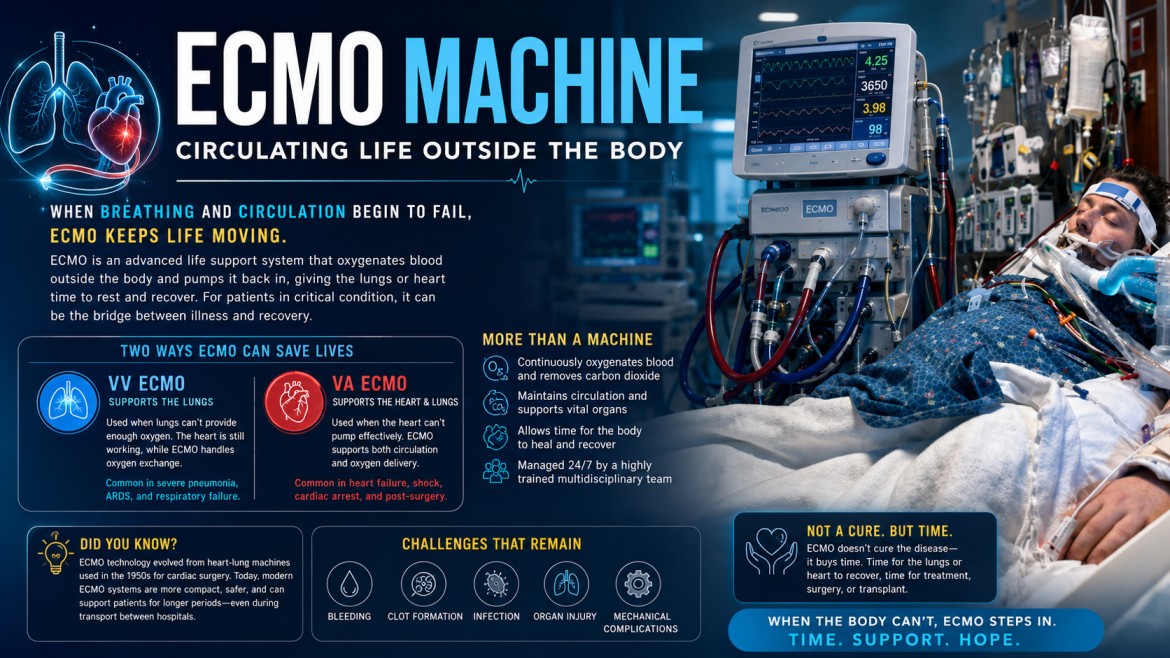
The system works by removing blood from the body through large tubes called cannulas, circulating it through an ECMO circuit, and then returning it to the patient. Inside the circuit, the blood is oxygenated, carbon dioxide is removed, temperature is regulated, and circulation is maintained.
By supporting oxygen delivery and blood flow, ECMO reduces the workload on damaged lungs or a failing heart while critical recovery takes place.
Two Different Forms of Support
Not every patient requires the same type of ECMO support.
VV ECMO (Venovenous ECMO) is mainly used when the lungs can no longer provide enough oxygen despite mechanical ventilation. The heart continues pumping normally while the ECMO system supports oxygen exchange externally. It is commonly used in severe respiratory failure, ARDS, and pneumonia.
VA ECMO (Venoarterial ECMO) supports both circulation and oxygen exchange when the heart can no longer pump effectively. It may be used during severe heart failure, cardiogenic shock, cardiac surgery complications, or cardiac arrest.
In both forms, ECMO provides temporary support while clinicians treat the underlying condition.
More Than a Machine in the ICU
Although ECMO is highly technological, its use depends heavily on human expertise.
At the bedside, teams of intensivists, surgeons, perfusionists, nurses, respiratory therapists, and technicians continuously monitor the patient’s condition.
Every detail matters:
- Blood pressure
- Oxygen saturation
- Blood clotting
- Organ function
- Temperature
- Fluid balance
- Pump performance
Even small complications can rapidly become life-threatening.
Managing ECMO therefore requires constant attention, careful judgment, and coordinated teamwork throughout the day and night.
How Modern ECMO Systems Have Changed
Modern ECMO systems are far more advanced than earlier generations. Many now use compact blood pumps, advanced membrane oxygenators, heparin-coated tubing, portable support systems, and digital monitoring technology to improve safety, efficiency, and long-term support.
Modern ECMO systems can now support critically ill patients during transport and even between hospitals. The technology has advanced rapidly in recent years, especially during major respiratory outbreaks that increased the need for prolonged life support.
Today’s ECMO machines are designed for greater safety, durability, and efficiency, making them far more reliable than earlier systems.
Where Challenges Still Exist
Despite major progress, ECMO remains one of the most complex forms of life support in medicine.
Because blood continuously contacts artificial tubing and membranes, patients remain at risk for:
Bleeding
Clot formation
Stroke
Infection
Organ injury
Mechanical complications
ECMO requires prolonged anticoagulation and highly specialized care, making the balance between bleeding risk and clot prevention a major clinical challenge.
The most important role of ECMO is not to cure disease directly,
but to provide time, time for the lungs or heart to recover, time for surgery or transplantation, and time for further treatment when the body cannot sustain life on its own.
Why ECMO Matters
For some critically ill patients, ECMO becomes the final option when standard treatments are no longer enough.
It has supported premature newborns, patients with severe respiratory failure, individuals after cardiac surgery, and those awaiting transplant.
In many cases, ECMO serves as a bridge between life-threatening illness and the possibility of recovery.
The Human Side of Circulating Life
For families, watching blood move outside the body through tubes and machines can feel frightening and unreal. The ICU is filled with alarms, monitors, pumps, and uncertainty. Yet within that environment, ECMO often represents hope.
For many families, the sound of the ECMO machine becomes associated with survival. Each hour on ECMO can provide more time to recover, receive treatment, or simply remain together.
Behind every ECMO circuit is not only advanced engineering,
but also a team working to sustain life at its most fragile.
Closing Thought
The ECMO machine transformed the idea of artificial circulation from a temporary surgical technique into one of the most advanced forms of life support in modern medicine.
From early heart-lung bypass systems to today’s sophisticated extracorporeal technology, ECMO continues to evolve through engineering, critical care, and biomedical science.
Its purpose is remarkable:
to keep oxygen and circulation moving when the body can no longer do so alone.