A patient suddenly stops breathing.
The room becomes tense.
In those first critical minutes, survival depends on rapid, effective action.
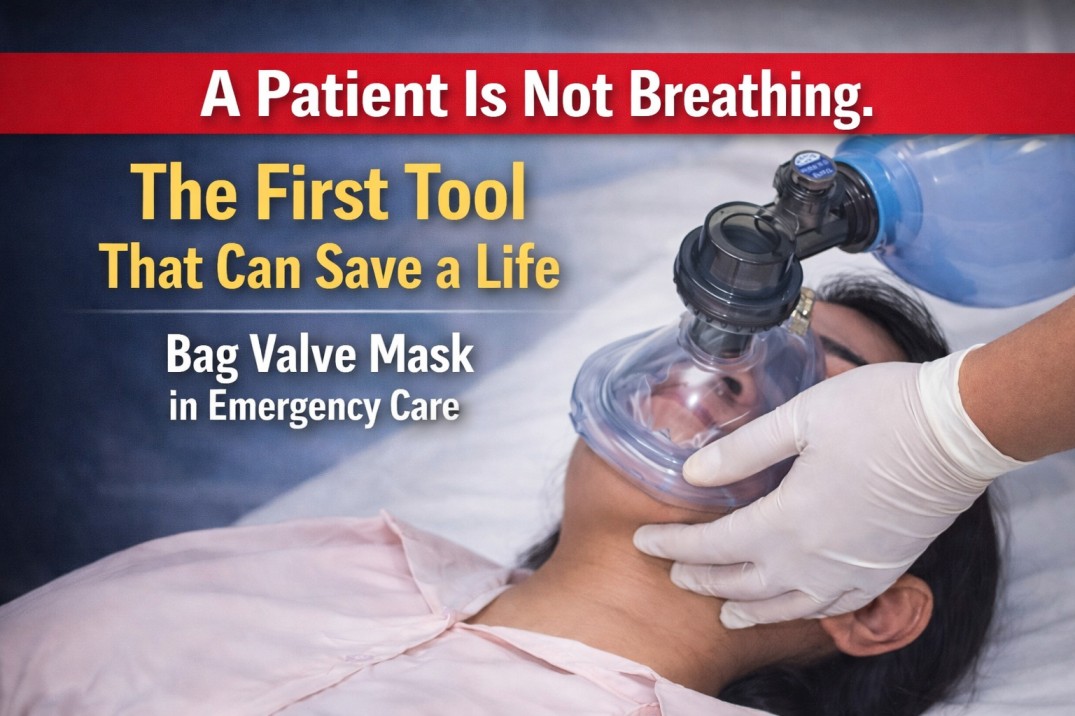
Before advanced equipment arrives or an airway is secured, healthcare professionals often rely on one essential device, the Bag Valve Mask (BVM). Portable, simple, and highly effective, it remains one of the most important tools in emergency and critical care.
Understanding the Urgency of Respiratory Emergencies
Oxygen deprivation to vital organs occurs very quickly when breathing is insufficient or ceases altogether. Without adequate oxygen to the brain, brain injury can begin as soon as four (4) to six (6) minutes after not having enough oxygen. Timely intervention is critical to prevent permanent neurological injury and increase the likelihood of successful resuscitation.
The use of a Bag Valve Mask will provide immediate positive pressure ventilation to the patient's lungs and will provide oxygen to the patient until a more definitive airway is established, or the patient is put on a mechanical ventilation device.
Origin and Development
The primary method of resuscitating individuals by rescuers before the creation of modern ventilators was mouth-to-mouth resuscitation; while this is effective for saving lives, there are many significant drawbacks, such as the possibility of infection, variable oxygen delivery rates, fatigue on the behalf of the rescuer due to continuous resuscitation, and the difficulty in assessing patients during transport.
In the 1950s, a revolutionary development was made when Danish anesthesiologist Henning Ruben combined efforts with German engineer Holger Hesse to create the first practical reusable (self-inflating) manual resuscitator.
Ambu, the Danish medical device manufacturer that created this device for the practical use of the resuscitator, has become commonly referred to by health care providers as the Ambu bag.
This innovation was instrumental in revolutionizing the field of emergency medicine, creating a method of transporting assistance for creating artificial ventilation that was much safer, less cumbersome (due to portability), and more effective than prior methods, especially in the prehospital care environment, as well as in disaster response settings.
Design and Working Principle
The Bag Valve Mask is designed to deliver controlled breaths to patients who are not breathing adequately.
Its key components include:
- A self-inflating ventilation bag
- A one-way valve system to prevent rebreathing
- A patient face mask to create an airtight seal
- An oxygen reservoir, often attached to increase oxygen concentration
When the clinician compresses the bag, air or oxygen is delivered into the lungs. Upon release, the bag automatically re-expands, drawing in fresh gas for the next ventilation cycle. This manual process allows immediate respiratory support in both hospital and field environments.
Key Clinical Specifications
Modern Bag Valve Masks are designed to deliver effective manual ventilation in emergency settings.
Typical adult devices have a bag capacity of about 1.5 litres, allowing delivery of approximately 500–600 mL of air per breath at a ventilation rate of 10–12 breaths per minute.
When connected to an oxygen source with a reservoir, the device can deliver up to nearly 100% oxygen, significantly improving patient oxygenation during critical moments. Many models also include pressure safety valves around 40 cm H₂O to reduce the risk of lung injury.
Importantly, clinical studies show that improper mask sealing or technique can reduce ventilation effectiveness by up to 50%, highlighting the need for proper training.
Clinical Importance in Emergency Care
Below are examples of common uses of the Bag Valve Mask (BVM):
- Cardiac Arrest
- Acute Respiratory Failure
- Severe Asthma Attack - Acute Exacerbation
- Overdose / Poisoning
- Trauma / Shock
- Neonatal/Pediatric Resuscitation
The BVM is frequently used preemptively before attempting more advanced airway interventions (e.g., Endotracheal Intubation). As a result, the BVM provides a necessary means of supplying oxygen to the patient during the initial phase of resuscitation and as a bridge to provide the patient with effective mechanical ventilation.support when an appropriate intervention can be performed.
Practical Insights from Clinical Use
The Bag Valve Mask has greatly enhanced the provision of prehospital emergency service care; it gave Paramedics a means of providing ventilation to patients while being transported. To this day, it is a major component of Basic Life Support (BLS), and Advanced Life Support (ALS) protocols worldwide.
The design of Bag Valve Masks will continue to undergo advancements; many devices now include features such as Monitoring pressure valves, Enhanced ergonomics of the masks, and Feedback systems – all of which help provide better safety and usability. In many cases where mechanical ventilation is available, the BVM is still the primary manual ventilation device in numerous life-threatening situations.
Conclusion
The Bag Valve Mask (BVM) illustrates the power of an uncomplicated medical device to assist health care professionals in performing essential life-giving breaths quickly.
Portable and dependable, the BVM allows health care practitioners to give immediate essential lifesaving ventilation to their patients.
While advances in technology continue to improve emergency medical services, the practice of emergency medical care is still contingent upon quick actions and skilled clinicians.
In many cases, an individual’s life provides evidence that a small tool, combined with the skills of a trained operator, can enable a patient to survive.