In critical care, deterioration often begins quietly.
The monitor may appear stable.
Oxygen saturation may still reassure.
The patient may still be breathing.
Yet, the physiology may already be shifting.
Before alarms sound and before clinical signs become obvious, there is a brief window where change can be detected.
Capnography will demonstrate what the body is attempting to communicate.
What Is Happening Inside the Body?
The body is constantly engaged in a continuous exchange with every breath. As oxygen enters, carbon dioxide (CO₂) is expelled.
This process reflects the coordination of metabolic, circulatory, and ventilatory systems working together.
Although CO₂ is often described as a waste product because it is removed from the body, it also serves as an important indicator of a patient’s physiological status.
When this balance is disrupted, CO₂ levels change in meaningful ways:
Decreased ventilation leads to increased CO₂
Impaired circulation reduces the amount of CO₂ delivered to the lungs
Metabolic changes alter the overall pattern of CO₂ in the body
These changes can occur before the onset of clinical symptoms, making them valuable early indicators of underlying physiological disturbances.
The Role of Capnography
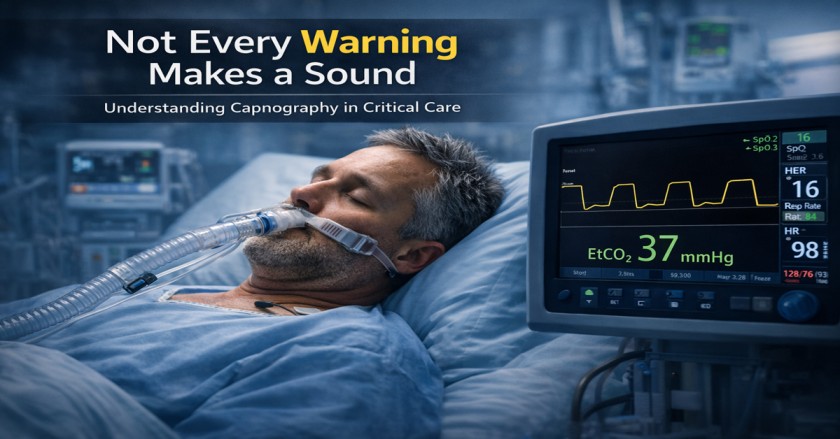
Capnography measures the concentration of carbon dioxide in exhaled air and presents it in two key ways:
A numerical value, known as end-tidal CO₂ (EtCO₂)
A graphical waveform, referred to as a capnogram
It provides continuous, real-time monitoring on a breath-by-breath basis.
While pulse oximetry reflects oxygenation status, capnography offers direct insight into ventilation and its interaction with circulation.
Clinical Importance After Airway Management
The clinical focus changes when the airway is secured by either intubation or manual ventilation.
Determining if the patient can breathe is no longer the only concern now there is an additional concern to measure if ventilation is occurring adequately.
Capnography is an important part of the evaluation to determine if the endotracheal tube is being placed in the proper position, to identify early signs of hypoventilation or hyperventilation, aid in identification and assessment of obstructive airway disease, and guide safe monitoring during sedation and the administration of anesthetics.
Importantly, capnography results do not wait until a situation has worsened to show the result. Capnography will demonstrate changes that occur before the full extent of the change occurs.
Interpreting the Waveform
The capnogram represents more than a visual display—it is a dynamic representation of respiratory physiology.
A normal waveform indicates effective gas exchange and smooth exhalation.
However, subtle deviations can signal significant concerns:
An elevated baseline may suggest rebreathing
A sloping plateau can indicate airway obstruction
A sudden decrease may reflect disconnection, apnea, or circulatory collapse
Each breath produces a waveform.
Each waveform conveys clinically relevant information.
In Critical Situations
During resuscitation, capnography becomes particularly valuable.
A decreasing EtCO₂ level may indicate inadequate chest compressions.
Conversely, a sudden increase can signal the return of spontaneous circulation (ROSC), sometimes even before a pulse is detectable.
In this way, capnography serves as a bridge between ventilation and circulation, offering real-time physiological feedback.
A Subtle but Essential Tool
Capnography does not replace clinical judgment.
Rather, it complements it by providing continuous, objective data.
It operates quietly in the background, yet its value becomes evident when early recognition is essential.
In high-pressure environments, where decisions must be made without delay, this steady stream of information can guide actions, support clinical assessment, and enhance patient safety.
Closing Reflection
In emergency medicine and critical care, early recognition drives many outcomes. Many critical events may not exhibit dramatic changes, and warning systems may not function immediately or provide obvious information.
Most clinically relevant signals are found in subtle variations present in each breath. In medicine, each breath does more than sustain life. It carries information, reflects physiology, and, when observed carefully, tells a story.